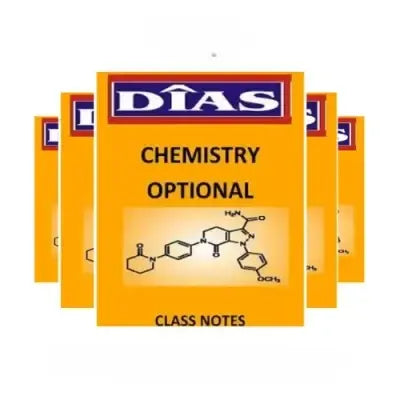


Dias IAS Chemistry Optional Notes 2025-26
About DIAS IAS Chemistry Optional Notes
The DIAS IAS Chemistry Optional Notes is a printed UPSC study material set sold by UPSC Store β India’s trusted source for genuine, latest-batch civil services preparation books. This page covers full booklet details, syllabus coverage, pricing, shipping, and frequently asked questions. Useful for UPSC CSE, BPSC, UPPSC, MPPSC, RAS and other state PSC examinations.
DIAS IAS Chemistry Optional Notes 2025-26 β 10 English Medium Printed Booklets for UPSC Mains Optional Paper
Related: Chemistry optional Β· Optional subjects
Product Overview
| Feature | Details |
|---|---|
| Booklets Count | 10 Individual Printed Booklets β Full UPSC Chemistry Optional Paper 1 and Paper 2 Coverage |
| Language | English Medium |
| Publisher | DIAS IAS (Chemistry Optional Class Notes Series) |
| Edition | 2025-26 β Latest Genuine Batch |
| Condition | Brand New, Unmarked, Fresh Stock |
| Format | High-Quality Printed Booklets β Spiral or Book Binding |
| Paper Quality | 75 GSM Ultra-White β Highlighter Safe, Zero Bleed-Through |
| Shipping | Pan India Delivery in 3-5 Business Days β Tracked |
| Also Useful For | BPSC, UPPSC, MPPSC, RAS and all State PSC examinations with Chemistry as optional |
Complete Booklet Catalog
This 6-booklet set from DIAS IAS covers the entire UPSC Chemistry Optional syllabus across Paper 1 and Paper 2, making it the most structured printed resource available for serious UPSC Mains aspirants. Whether you are a chemistry graduate preparing independently or a classroom student looking for reliable printed backup material, these booklets are organized topic by topic for efficient study and last-minute revision.
- Booklet 1: Atomic Structure and Chemical Bonding β Quantum mechanical model of the atom, wave functions and orbitals, Aufbau principle, Hund’s rule, Pauli exclusion principle, ionic and covalent bonding, VSEPR theory, valence bond theory, molecular orbital theory, hybridization, resonance, dipole moments, and intermolecular forces relevant to UPSC Paper 1.
- Booklet 2: States of Matter and Thermodynamics β Gaseous state laws, kinetic theory of gases, real gases and van der Waals equation, liquefaction; thermodynamic laws including zeroth, first, second and third laws, entropy, Gibbs free energy, Hess’s law, Kirchhoff’s law, spontaneity criteria, and thermodynamic functions as tested in UPSC Chemistry Optional.
- Booklet 3: Chemical Equilibrium, Electrochemistry and Kinetics β Law of mass action, Le Chatelier’s principle, ionic equilibria, buffer solutions, solubility products; Faraday’s laws, electrode potentials, Nernst equation, fuel cells, corrosion; reaction rates, rate laws, activation energy, Arrhenius equation, reaction mechanisms, and catalysis for UPSC Mains Paper 1.
- Booklet 4: Coordination Chemistry and Organometallics β Werner’s theory, IUPAC nomenclature of complexes, isomerism, crystal field theory, splitting patterns, ligand field theory, spectrochemical series, magnetic properties, charge transfer spectra; organometallic compounds, 18-electron rule, metal carbonyls, Wilkinson’s catalyst, and applications in catalysis for UPSC Chemistry Optional.
- Booklet 5: Main Group and Transition Element Chemistry β Properties and reactivity trends of s-block and p-block elements, halides, oxides, oxoacids; d-block element chemistry, variable oxidation states, complex formation, colour, catalytic properties; f-block elements, lanthanide contraction, actinides, and separation techniques as per the UPSC optional chemistry syllabus.
- Booklet 6: Stereochemistry and Reaction Mechanisms β Configuration and conformation, optical activity, chirality, enantiomers, diastereomers, R-S nomenclature, E-Z nomenclature, conformational analysis of cyclohexane; nucleophilic substitution SN1 and SN2, elimination E1 and E2, electrophilic addition, free radical mechanisms, and carbocation and carbanion stability for UPSC Paper 2.
- Booklet 7: Organic Functional Group Chemistry β Part 1 β Chemistry of alkanes, alkenes, alkynes, aromatic compounds; electrophilic aromatic substitution, nucleophilic aromatic substitution; alcohols, ethers, epoxides, phenols, thiols; halogenated compounds, organohalogens, reactions and synthetic applications as required for UPSC Chemistry Optional Paper 2 preparation.
- Booklet 8: Organic Functional Group Chemistry β Part 2 β Aldehydes and ketones, nucleophilic addition reactions, Cannizzaro reaction, Aldol condensation; carboxylic acids and derivatives, acyl substitution, ester hydrolysis, amides; nitrogen-containing compounds including amines, diazonium salts, coupling reactions, heterocyclic chemistry, and named reactions as per UPSC Mains chemistry optional syllabus.
- Booklet 9: Spectroscopy, Photochemistry and Analytical Chemistry β UV-visible spectroscopy, Beer-Lambert law, IR spectroscopy, fingerprint region, NMR spectroscopy, chemical shift, spin-spin coupling, mass spectrometry, fragmentation patterns; photochemical reactions, Jablonski diagram, fluorescence and phosphorescence; analytical techniques including chromatography, gravimetry, titrimetry, and instrumental analysis for UPSC optional exam.
- Booklet 10: Biochemistry, Polymer Chemistry and Interdisciplinary Topics β Amino acids, proteins, enzymes and enzyme kinetics, carbohydrates, lipids, nucleic acids, DNA replication and protein synthesis; addition and condensation polymers, rubber, plastics; green chemistry principles, supramolecular chemistry, nanomaterials, and previous year UPSC Chemistry Optional question trends with answer-writing guidance.
In-Depth Content Breakdown: Booklet by Booklet
Booklet 1: Atomic Structure and Chemical Bonding
Atomic structure is the foundational topic for UPSC Chemistry Optional Paper 1. This booklet opens with quantum mechanics, covering wave-particle duality, the SchrΓΆdinger equation, and the physical meaning of wave functions. Orbital shapes, quantum numbers, and electronic configurations are presented with clarity. The UPSC Mains exam consistently tests conceptual depth on bonding theories, and this booklet addresses VSEPR, valence bond theory, molecular orbital diagrams for homonuclear and heteronuclear diatomics, bond order calculations, and the distinction between sigma and pi bonds.
What sets this DIAS IAS booklet apart is its structured approach to hybridization and intermolecular forces β topics that frequently appear in UPSC Chemistry Optional as both short-answer and extended questions. Hydrogen bonding, van der Waals interactions, and their consequences on physical properties are explained with comparative tables and orbital energy diagrams. The content is aligned precisely to the UPSC syllabus, ensuring aspirants do not waste time on material outside the exam scope while building genuine understanding of bonding principles.
Booklet 2: States of Matter and Thermodynamics
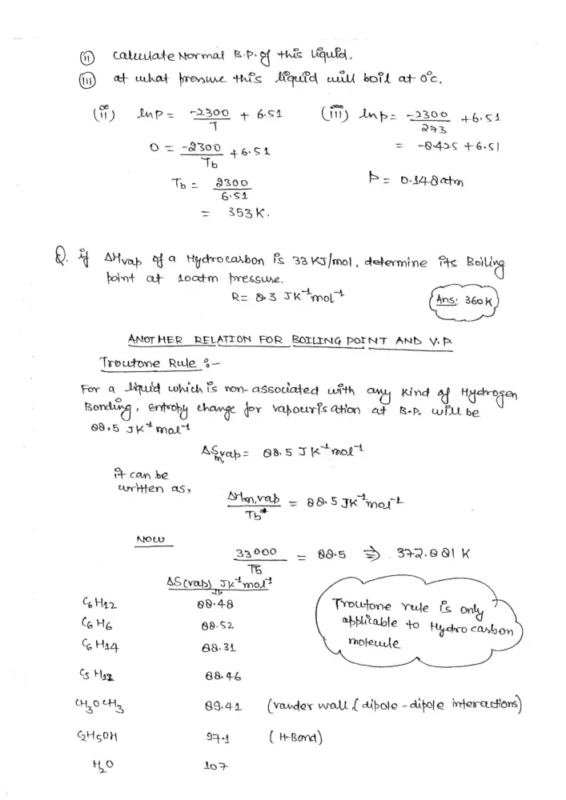
Thermodynamics is one of the highest-weightage areas in UPSC Chemistry Optional Paper 1, and this booklet treats it with the depth the exam demands. The gaseous state section covers kinetic molecular theory, Maxwell-Boltzmann distribution curves, mean free path, and deviations from ideal behavior using van der Waals and other equations of state. Liquefaction of gases, critical constants, and reduced equations of state are included with numerical examples similar to UPSC Mains question patterns from previous years.
The thermodynamics portion covers all four laws with derivations, entropy calculations for reversible and irreversible processes, Gibbs and Helmholtz energy, Maxwell relations, and chemical potential. Kirchhoff’s equation for temperature dependence of enthalpy and the Born-Haber cycle for lattice energies are explained with worked problems. DIAS IAS has structured this booklet so that each law flows logically into the next, making it especially useful for aspirants who buy printed notes to build a connected understanding rather than memorizing isolated facts.
Booklet 3: Chemical Equilibrium, Electrochemistry and Kinetics
Chemical equilibrium, electrochemistry, and kinetics together represent a significant portion of UPSC Chemistry Optional Paper 1. This booklet begins with the law of mass action, equilibrium constants in terms of concentration and pressure, and their interrelationship. Le Chatelier’s principle is applied across temperature, pressure, and concentration changes with case studies. Ionic equilibria including acid-base theories, pH calculations, buffer action, and solubility product applications are covered with numerical problems matched to UPSC exam standards.
The electrochemistry section develops from Faraday’s laws through galvanic cell thermodynamics, the Nernst equation, standard electrode potentials, and concentration cells. Fuel cells and corrosion mechanisms are included as applied topics. Chemical kinetics covers integrated rate laws for zero, first, second, and nth order reactions; Arrhenius theory; transition state theory; and mechanisms involving intermediates. DIAS IAS presents each topic with the dual-layer approach that helps aspirants in both understanding concepts for UPSC Mains and applying them to numerical problems.
Booklet 4: Coordination Chemistry and Organometallics
Coordination chemistry is a specialty area that UPSC Chemistry Optional tests in considerable detail, and this booklet from DIAS IAS handles both classical and modern theories. Werner’s postulates, effective atomic number concept, and IUPAC nomenclature rules are presented first, followed by the various types of isomerism β geometric, optical, linkage, and coordination isomerism β with structural diagrams. Crystal field theory is developed fully, including splitting patterns for octahedral, tetrahedral, and square planar complexes, crystal field stabilization energies, and the spectrochemical series.
Magnetic susceptibility, colour of coordination compounds, and charge transfer spectra are treated with the level of analytical depth UPSC examiners expect. The organometallics section introduces the 18-electron rule, metal carbonyls and their bonding, metallocenes, and catalytic applications including the Wacker process and Ziegler-Natta polymerization. Wilkinson’s catalyst for homogeneous hydrogenation is detailed with mechanism steps. This booklet is structured to help aspirants who buy DIAS IAS chemistry optional notes answer multi-part questions on transition metal chemistry with precision.
Booklet 5: Main Group and Transition Element Chemistry
The chemistry of main group elements is covered systematically in this booklet, starting with s-block elements β alkali and alkaline earth metals, their anomalous properties, crown ether complexes, and biological roles. P-block chemistry is treated group by group, with emphasis on the chemistry of boron, carbon, nitrogen, oxygen, sulfur, and halogens β including hydrides, halides, oxides, and oxoacids that recur regularly in UPSC Chemistry Optional questions. Anomalous behavior of first-row elements is compared with heavier congeners using periodic trends.
The transition element section covers the full d-block with emphasis on variable oxidation states, complex formation, catalytic activity, and colour β connecting to concepts introduced in Booklet 4. Lanthanide and actinide chemistry receives dedicated coverage, including lanthanide contraction, its consequences on chemistry of third transition series, paramagnetism, and separation techniques relevant to UPSC. This booklet consolidates inorganic descriptive chemistry in a form that supports both answer writing for UPSC Mains and last-stage revision before the exam.
Booklet 6: Stereochemistry and Reaction Mechanisms
Stereochemistry is the gateway to UPSC Chemistry Optional Paper 2, and this DIAS IAS booklet builds the conceptual framework carefully. Configuration using R-S and E-Z nomenclature, optical activity, specific rotation, enantiomers, diastereomers, meso compounds, and racemic mixtures are explained with three-dimensional structural representations and Fischer, Newman, and sawhorse projections. Conformational analysis of ethane, butane, and cyclohexane β including chair and boat forms β is presented with energy diagrams matching UPSC exam question depth.
Reaction mechanism fundamentals are introduced here and flow into the functional group booklets that follow. The SN1 and SN2 mechanisms are compared with stereochemical outcomes, substrate structure effects, solvent and nucleophile effects, and leaving group ability. E1 and E2 eliminations are covered with Zaitsev and Hofmann product predictions. Carbocation rearrangements, carbanion stabilization, and radical mechanisms are analyzed systematically. DIAS IAS has designed this booklet to ensure aspirants can write mechanistic answers for UPSC Mains with proper arrow-pushing and step-by-step logic.
Booklet 7: Organic Functional Group Chemistry β Part 1
This booklet covers the first half of organic functional group chemistry as required by the UPSC Chemistry Optional Paper 2 syllabus. Alkane reactions focus on free radical halogenation, mechanism selectivity, and reactivity-selectivity principle. Alkene and alkyne reactions include electrophilic addition, Markovnikov’s rule, anti-Markovnikov addition, hydroboration-oxidation, ozonolysis, and metal-catalyzed hydrogenation. Aromatic chemistry covers electrophilic aromatic substitution in detail β nitration, sulfonation, halogenation, Friedel-Crafts reactions β along with directing effects and ortho-para ratio discussions.
Alcohols, phenols, and ethers are treated with their preparations, reactions, acidic character comparisons, and industrial applications. Epoxide chemistry and ring-opening under acidic and basic conditions is included as it frequently appears in UPSC Chemistry Optional. Halogenated organic compounds β alkyl and aryl halides β are covered with nucleophilic and elimination reactions linked back to Booklet 6. DIAS IAS structures each functional group section with preparation methods, physical properties, chemical reactions, and UPSC-relevant applications in a sequence that supports efficient answer writing.
Booklet 8: Organic Functional Group Chemistry β Part 2
Carbonyl chemistry dominates the first half of this booklet. Aldehydes and ketones are covered with nucleophilic addition reactions β cyanohydrin formation, Grignard addition, reductive amination, Wittig reaction, and the Aldol condensation with its crossed and intramolecular variants. Cannizzaro reaction, Clemmensen and Wolff-Kishner reductions, and oxidation reactions are presented with mechanisms. Carboxylic acids and their derivatives β esters, anhydrides, amides, acid chlorides β are treated with acyl nucleophilic substitution mechanisms and Fischer esterification equilibria relevant to UPSC Paper 2.
The nitrogen-containing compound section covers primary, secondary, and tertiary amines, their basicity comparisons, reactions with nitrous acid, and Gabriel synthesis. Diazonium salt chemistry and azo coupling reactions are included as they connect to dye chemistry and UPSC applied questions. The heterocyclic chemistry portion covers pyrrole, furan, thiophene, pyridine, imidazole, indole, and quinoline β structures, aromaticity, and reactivity. Named reactions are compiled with mechanisms in a reference section that aspirants who buy DIAS chemistry optional notes consistently find invaluable during revision weeks.
Booklet 9: Spectroscopy, Photochemistry and Analytical Chemistry
Spectroscopy has grown in importance in UPSC Chemistry Optional, and this booklet covers all four major spectroscopic techniques. UV-visible spectroscopy covers Beer-Lambert law, chromophores, auxochromes, and conjugation effects on absorption maxima. IR spectroscopy focuses on functional group identification using characteristic absorption bands and the fingerprint region. NMR spectroscopy includes chemical shift trends, shielding and deshielding effects, spin-spin coupling, coupling constants, and structure determination from spectra β a skill that UPSC examiners test in applied structure-elucidation questions.
Mass spectrometry covers molecular ion peaks, fragmentation patterns, and common rearrangements such as McLafferty rearrangement. Photochemistry introduces the Jablonski diagram, Franck-Condon principle, intersystem crossing, fluorescence and phosphorescence distinctions, and Norrish reactions. Analytical chemistry covers gravimetric methods, titrimetric analysis, complexometric titrations with EDTA, redox titrations, and instrumental techniques including flame photometry, atomic absorption spectroscopy, and HPLC. This booklet is structured to help aspirants build score-earning answers for UPSC Chemistry Optional questions on structure determination and analytical methods.
Booklet 10: Biochemistry, Polymer Chemistry and Interdisciplinary Topics
Biochemistry begins this final booklet with amino acid classification, peptide bond geometry, protein structure levels, enzyme kinetics covering Michaelis-Menten equation, competitive and non-competitive inhibition. Carbohydrate chemistry covers monosaccharide configurations, anomers, mutarotation, disaccharide linkages, and polysaccharide structures. Lipids include fatty acid chemistry, soap and detergent action, and membrane structure. Nucleic acids cover DNA double helix geometry, base pairing rules, and an overview of replication and protein synthesis as per UPSC syllabus requirements.
Polymer chemistry covers addition polymerization mechanisms β radical, cationic, and anionic β along with condensation polymers, copolymers, vulcanization of rubber, and polymer properties. Green chemistry principles, atom economy, and environmentally benign synthesis are included as contemporary application topics. Supramolecular chemistry and nanomaterial basics round out the syllabus coverage. The booklet closes with a curated section on UPSC Chemistry Optional previous year question analysis, answer-writing strategy for 20-mark questions, and high-yield topic prioritization β making it an ideal resource for aspirants in the final phase of preparation.
Physical Construction and Quality Standards
DIAS IAS Chemistry Optional printed notes are manufactured to withstand daily intensive study use across an entire UPSC preparation cycle β from initial reading through multiple revision rounds leading up to Mains. Every physical aspect has been selected with the working habits of a serious UPSC aspirant in mind.
Paper Quality: 75 GSM Anti-Glare White Paper
Each booklet in this set uses 75 GSM ultra-white paper with a calibrated anti-glare finish that significantly reduces eye strain during the extended reading sessions that UPSC Chemistry Optional study demands. The paper’s high opacity ensures that text, diagrams, and structural formulas printed on one side do not bleed through to the reverse, maintaining legibility across long sessions. Multiple highlighter colors β yellow, green, pink, and orange β as well as gel pens and ballpoint pens work without smearing, making color-coded revision of reaction mechanisms and spectroscopy data fully practical.
Printing Technology: High-Resolution Laser Printing
All 6 Booklets use high-resolution laser printing technology that renders complex organic reaction mechanisms, molecular orbital diagrams, spectroscopy charts, coordination compound structures, and stereochemical projections with sharp, examination-grade clarity. Toner fusion in laser printing ensures that pages remain smudge-proof even when handled repeatedly over months of daily use. Energy level diagrams, IR absorption tables, and NMR coupling charts that appear frequently in UPSC Chemistry Optional notes are reproduced with the precision needed for unambiguous reading, unlike photocopied or inkjet-printed materials that degrade with use.
Binding and Durability
The binding style β spiral or book binding depending on stock β is selected to serve chemistry optional aspirants who need their notes to remain flat while simultaneously referring to the text and writing answers or working numerical problems. Spiral-bound booklets open completely flat on a desk, eliminating the hand strain of holding pages open during long study sessions. The 300 GSM thick cover protects interior pages from corner damage, moisture, and daily backpack wear. Book-bound editions provide a compact form factor suitable for portability and organized shelf storage across the full 6-booklet set.
Key Features and Study Design
DIAS IAS Chemistry Optional Notes 2025-26 are designed specifically for UPSC Mains aspirants who need structured, syllabus-mapped printed material that covers both conceptual depth and answer-writing precision across the full 500-mark optional paper.
- Full UPSC Syllabus Mapping: Every topic listed in the official UPSC Chemistry Optional syllabus for Paper 1 and Paper 2 is covered across the 6 Booklets, with no gaps. Aspirants who buy this set do not need to supplement it with multiple reference books for basic conceptual coverage.
- Structured for Answer Writing: Content is presented in a format that mirrors UPSC Mains answer structure β each concept is developed with definition, explanation, mechanism or derivation, application, and UPSC-relevant examples, enabling aspirants to internalize the answer-writing pattern naturally.
- Reaction Mechanism Diagrams: Organic chemistry booklets include fully drawn reaction mechanisms with electron-flow arrows, intermediate structures, and stereochemical outcomes clearly labeled β a level of visual detail that is essential for scoring in UPSC Chemistry Optional Paper 2.
- Previous Year Question Alignment: DIAS IAS has incorporated analysis of past UPSC Chemistry Optional question papers into the content design, ensuring that high-frequency topics receive proportionally deeper coverage and that aspirants who buy this material are prepared for question types that recur in UPSC Mains.
- Self-Study Ready: These notes are structured so that aspirants who have not attended DIAS IAS classroom coaching can use them independently. Concepts are explained from first principles with sufficient context that a chemistry graduate preparing for UPSC without coaching can follow and build upon the material effectively.
Shipping, Packaging and Delivery
Every order of DIAS IAS Chemistry Optional Notes 2025-26 is packed with care to ensure all 6 Booklets arrive in pristine, classroom-fresh condition. Each set is individually shrink-wrapped to protect against moisture and dust, then placed inside a double-walled corrugated cardboard box with foam corner protectors and internal padding that prevent spine damage and page compression during transit. The outer box is sealed with reinforced adhesive tape and marked “Handle with Care β Printed Study Material” to ensure appropriate handling by courier partners. Orders are dispatched within 24 hours of confirmation on business days.
Pan India delivery is completed in 3-5 business days through fully tracked courier services. A tracking ID is shared via email and WhatsApp as soon as the order is dispatched. For any queries about your order, missing booklets, or delivery status, contact our team directly on WhatsApp at +91 70045 49563 β we respond within business hours. In the rare event that any booklet is found damaged or missing on delivery, a replacement is dispatched within 48 hours at no additional cost. We deliver to all pin codes across India including Tier 2 and Tier 3 cities.
Frequently Asked Questions (FAQ)
A: DIAS IAS has been a recognized name in UPSC Chemistry Optional coaching from Delhi’s Mukherjee Nagar coaching hub. Their class notes are structured to cover the full UPSC Mains syllabus across Paper 1 and Paper 2, with attention to conceptual depth, reaction mechanisms, and answer-writing format. Aspirants who have used these printed notes report that the syllabus coverage and topic sequencing are well-suited for both first-time reading and repeated revision leading up to UPSC Mains.
A: This set contains 10 individual printed booklets that together cover the complete UPSC Chemistry Optional syllabus β Paper 1 including physical chemistry, inorganic chemistry, and coordination chemistry, and Paper 2 covering stereochemistry, organic functional groups, spectroscopy, biochemistry, and polymer chemistry. All 6 Booklets are shipped together as a single set and arrive in one delivery within 3-5 business days of order placement.
A: The set listed on this product page is the English medium edition of DIAS IAS Chemistry Optional Notes 2025-26. Chemistry optional is predominantly taken by aspirants in English medium given the nature of the subject, especially for organic and physical chemistry topics where structural notation and nomenclature are standardized in English. If you require Hindi medium chemistry optional notes, please contact us on WhatsApp at +91 70045 49563 and we will check for availability.
A: Yes. The 6-booklet set is designed to cover the complete official UPSC Chemistry Optional syllabus for both Paper 1 and Paper 2 as published by the Union Public Service Commission. Paper 1 topics β atomic structure, bonding, thermodynamics, equilibrium, electrochemistry, kinetics, coordination chemistry, main group and transition element chemistry β are covered across Booklets 1 to 5. Paper 2 topics β stereochemistry, organic functional groups, spectroscopy, photochemistry, biochemistry, and polymers β are covered in Booklets 6 to 10.
A: The current price for the complete 6-booklet set of DIAS IAS Chemistry Optional Notes 2025-26 is displayed on this product page and reflects the cost of brand-new, freshly printed genuine stock. Given that chemistry optional accounts for 500 marks in UPSC Mains β the largest single scoring component β investing in quality printed notes is one of the highest-return study decisions an aspirant can make. The price includes all 6 Booklets, secure packaging, and pan India tracked delivery within 3-5 business days.
A: DIAS IAS is specifically known for its chemistry and science optional coaching and has built its notes around the depth that a subject-specialist institution brings. While Vision IAS is primarily a GS-focused institute, DIAS IAS concentrates heavily on optional subject preparation, which means their chemistry notes reflect a closer alignment with the UPSC Chemistry Optional question paper style β including mechanism-level depth in organic chemistry and derivation-level coverage in physical chemistry that GS-focused institute notes sometimes compress or omit.
A: Yes. The edition you are buying is the 2025-26 batch, which reflects the latest UPSC Chemistry Optional syllabus and recent question paper trends. DIAS IAS reviews and updates its optional notes each academic year to incorporate changes in UPSC exam focus areas, recently introduced topics in applied chemistry, and adjustments in question formats such as the shift toward more analytical and applied questions in recent UPSC Mains papers. This ensures aspirants who buy this set are working with current and relevant material.
A: Absolutely. These notes are structured to be self-study ready for chemistry graduates preparing for UPSC independently. Concepts are explained from first principles with diagrams, mechanisms, and derivations that do not assume prior classroom exposure to DIAS IAS teaching. Many aspirants across India β especially those outside Delhi who cannot attend Mukherjee Nagar coaching β buy these printed notes as their primary study resource and supplement them with standard reference books like Lee for inorganic chemistry or Morrison and Boyd for organic chemistry.
A: These booklets use 75 GSM ultra-white paper chosen for high opacity β multiple highlighter colors and gel pens work without bleed-through to the reverse side, ideal for color-coded revision. Chemistry optional study benefits greatly from color-coded annotation β for example, using one color for mechanisms, another for exceptions, and another for UPSC previous year question markers. The anti-glare finish also reduces eye fatigue during the extended daily study sessions that optional subject preparation requires.
A: All 6 Booklets are shrink-wrapped together and placed in a double-walled corrugated cardboard box with foam corner protectors and internal padding that protect against spine damage, page compression, and moisture during transit. The outer packaging is sealed with reinforced tape and marked appropriately for careful handling. Orders are dispatched within 24 hours on business days and arrive pan India within 3-5 business days with full tracking. If any booklet arrives damaged, a free replacement is dispatched within 48 hours β contact us on WhatsApp at +91 70045 49563.
A: Chemistry is one of the more scoring optional subjects in UPSC Mains for candidates with a strong science background. It is largely objective in evaluation, rewards candidates who present structured answers with mechanisms and derivations, and has a stable syllabus. Chemistry optional is ideal for graduates in chemistry, pharmacy, chemical engineering, and related disciplines. Aspirants who buy DIAS IAS Chemistry Optional Notes benefit from a study resource that bridges academic chemistry knowledge and UPSC answer-writing requirements effectively, making it one of the most focused investments for UPSC optional preparation.
A: Yes. These DIAS IAS Chemistry Optional printed notes are useful for state civil services examinations that include chemistry as an optional subject, including BPSC, UPPSC, MPPSC, RAS, and other State PSC examinations. The syllabus overlap between UPSC Chemistry Optional and state PSC chemistry optional papers is substantial, especially in physical chemistry, inorganic descriptive chemistry, and core organic chemistry topics. Aspirants preparing for state PSC exams can use these notes as their primary resource and focus on any state-specific topics separately.
Summary
| Specification | Value |
|---|---|
| Booklets | 10 Printed Booklets |
| Language | English Medium |
| Paper | 75 GSM Ultra-White |
| Binding | Spiral or Book Binding |
| Delivery | 3-5 Business Days Pan India |
| Also Useful For | BPSC, UPPSC, MPPSC, RAS and all State PSC examinations with Chemistry as optional |
DIAS IAS Chemistry Optional Notes 2025-26 are available to buy online and ship from our store in Mukherjee Nagar, Delhi β the heart of India’s UPSC coaching ecosystem. Order today and receive your complete 6-booklet set with pan India delivery in 3-5 days.
Reference: Civil Services Examination
Customer Reviews 228
Content is comprehensive and student-friendly. Recommended for serious UPSC aspirants.
Notes bahut detailed hain aur exam ke liye perfectly designed.
Booklets bohot detailed hain aur examples bhi relevant hain. Quality print bhi badhiya hai.
Content quality and presentation dono excellent hain.
All 10 booklets are jam-packed with relevant content. Highly satisfied with this purchase.
No regrets, bilkul value for money!
Bohot helpful, printed quality bhi excellent hai aur concepts bilkul clear hain.
This is exactly what I was looking for my UPSC prep.
Aspirants Also Bought
More from the same category
About Dias IAS Chemistry Optional Notes 2025-26
Dias IAS Chemistry Optional Notes 2025-26 is a highly recommended UPSC study material from Dias IAS, specially designed for Chemistry Optional preparation. Available in English medium, this material is crafted to match the exact requirements of the UPSC Civil Services Examination syllabus β covering both Prelims and Mains comprehensively.
Product Details
- Institute: Dias IAS
- Subject: Chemistry Optional
- Medium: English
- Format: Printed
- Delivery: Pan-India delivery in 3β5 working days
- Format: Original printed material, verified authentic
Why Buy from UPSC Store?
- β 100% Genuine Printed Material β Original printed notes, no photocopies or fake copies
- β Fast Delivery β Ships within 24 hours, arrives in 3β5 days pan-India
- β Secure Packaging β Bubble-wrapped and boxed to prevent damage in transit
- β Trusted by 10,000+ Aspirants β India's most reliable UPSC material marketplace
- β WhatsApp Support β Get expert guidance on material selection before ordering
Frequently Asked Questions
Yes, all products at UPSC Store are 100% genuine printed materials. We do not sell photocopies or fake copies.
Orders are dispatched within 24 hours and delivered across India in 3β5 working days via reputed courier partners.
Yes, we accept returns within 7 days if the product is damaged or incorrect. Check our refund policy for details.
We recommend pairing this with current affairs notes and a UPSC test series for comprehensive preparation. Browse more in Chemistry, Optional, UPSC.